

Most denials are decided before the claim leaves your office. They begin at scheduling, when coverage goes unchecked, at registration, when a digit is mistyped, and in the chart, when the note does not support the code. Reducing claim denials means fixing those points one at a time, measuring the result by payer and by provider, and giving the work to people who do it every day. Quelin Healthcare Solutions provides medical billing, coding, auditing, credentialing, eligibility and prior authorization support, and denial management for practices that want to stop reworking the same claims.
This guide walks through the prevention routine in the order the claim travels, with the benchmarks and rules that matter in the United States.
TL;DR
- Denials cluster in a few causes: registration and eligibility errors, missing or invalid claim data, and authorization problems. Fix those first.
- Pull your own denial data by payer, reason code, CPT or HCPCS code and provider before changing any process. Patterns, not guesses, tell you where to act.
- The AMA's revenue cycle guide puts a healthy denial rate below 10%, with 2% to 3% exceptional, and a first-pass approval target of 95%.
- Coding and documentation drive improper payments: in CMS's 2024 data, incorrect coding and insufficient documentation account for most E/M errors.
- Prevention is a loop: verify, code, scrub, submit, track, train, repeat.
Table of Contents
- Why prevention beats rework
- Step 1: Find your own denial pattern
- Step 2: Lock down the front end
- Step 3: Keep credentialing and payer enrollment current
- Step 4: Make the chart support the code
- Step 5: Scrub claims before they go out
- Step 6: Train the people who touch the claim
- Step 7: Measure what matters
- Rules that change what you have to do
- When a claim is denied anyway
- Where we fit
- Our perspective
- FAQ
- Sources
Why prevention beats rework
A denied claim costs you twice: the staff time to find out why, and the delay in cash. Rework also does not fix the cause, so the next identical claim gets denied the same way.
The scale is large. An analysis of 850 hospitals' payment transactions, cited in an AHIMA Journal article on denials prevention, found initial denial rates among five national payers ranging from 7.5% to 11.1% of net patient service revenue. That is roughly $1 in every $10 of revenue at risk of nonpayment. The data is from 2017, but the lesson holds: the money at stake is a meaningful share of what you earn.
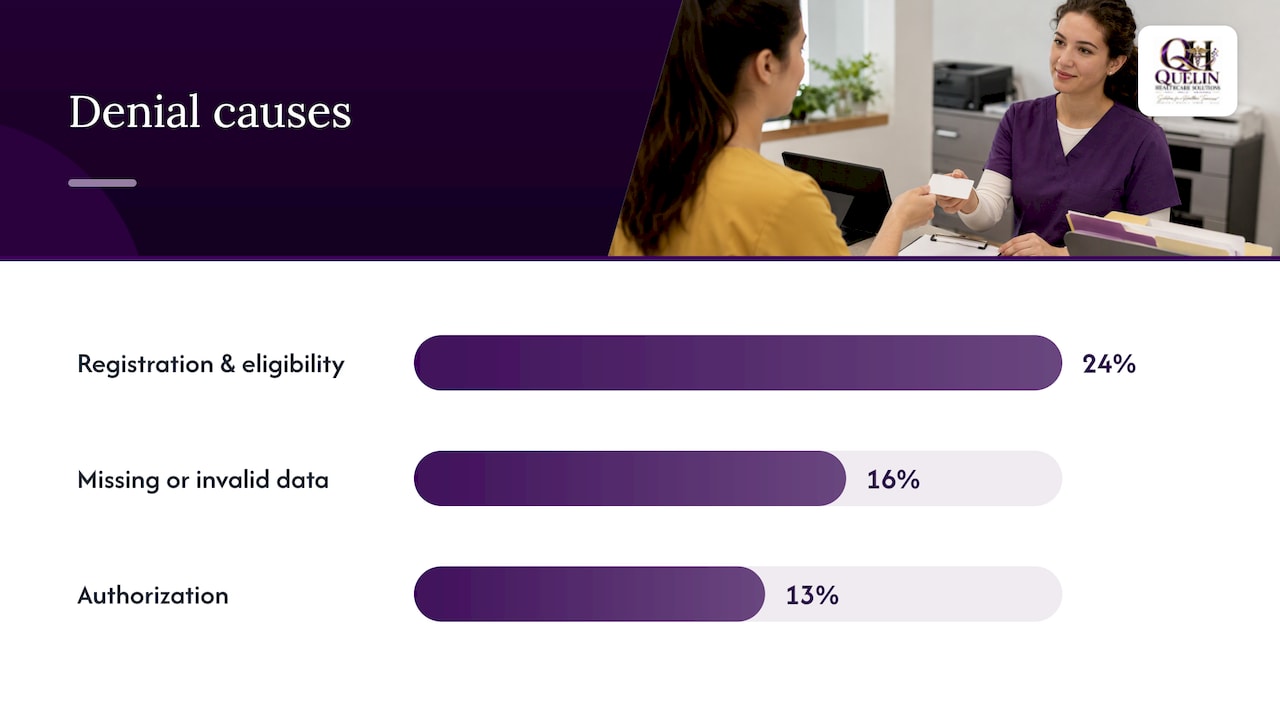
The causes are well documented. The AMA's STEPS Forward module on revenue cycle management, citing MGMA, lists the most common denial reasons: prior authorization, missing or incorrect information, medical necessity, procedure coverage, out-of-network physicians, duplicate claims, coordination of benefits, bundling, and timely filing limits. The same module cites Optum's 2024 index, which put registration and eligibility at 24% of root causes, missing or invalid claim data at 16%, and authorization at 13%.
Notice what these have in common. Almost none is a clinical dispute. They are administrative failures that a consistent process catches.
Step 1: Find your own denial pattern
National lists tell you where to look. Your data tells you what to fix.
The AHIMA guidance on managing denials in medical practices recommends a denials database that records every denial reason code and can be sliced by payer, reason, diagnosis, CPT or HCPCS code, and provider. From there:
- Trend your top 100 procedure codes by the percentage denied, by specialty and by physician.
- Give any code denied 100% of the time its own category. It usually points to a payer rule or a systematic billing error, not bad luck.
- Set a benchmark. AHIMA's guidance suggests denials of about 1.5% of gross revenue, rejections under 5% of electronic claims, and single-digit denial rates per payer.
- Review the numbers on a schedule with a small denial work team, so findings become changes.
Where it goes wrong: practices count denials but never group them. A total of "312 denials this month" says nothing. "Eighty-one denials for one E/M code from three providers at one payer" says exactly where to act.
AAPC's Knowledge Center describes a multispecialty group that saw a surge of "not medically necessary" denials on CPT 99214. At first the team assumed payer error. Grouping the claims by provider, diagnosis and denial code showed that three providers accounted for nearly 70% of the denied claims, with low-risk diagnoses and thin documentation of medical decision-making. The fix was provider education, internal guidance on 99213 versus 99214, and a pre-submission dashboard. Resubmitting the same notes would not have worked.
Building and maintaining this analysis is real work. Our auditing and denial management services are built around it, so your team gets the answer, not the spreadsheet.
Step 2: Lock down the front end
The front desk is where the largest share of avoidable denials starts. The HFMA training manual directs practices to verify insurance before service for scheduled patients and to confirm:
- benefit levels and in-network or out-of-network status
- deductible, coinsurance, copay and out-of-pocket maximum
- coverage effective dates
- pre-certification, authorization and referral requirements
The same manual says the scheduled, performed, billed and authorized CPT codes should match, with the ICD-10 diagnosis code correctly linked to the procedure.
The AMA's clean-claim workflow adds two checks: confirm that demographics and insurance are accurate and active, and confirm prior authorization and billing notes before submission. The AMA's guide sets a target of 99% accuracy for patient information.
Where it goes wrong:
- Eligibility is checked at scheduling but not again on the day of service, so coverage that lapsed in between goes unnoticed.
- Authorization is obtained for one code, and a different code is performed.
- A referral is on file, but for the wrong provider or the wrong date range.
- Insurance card details are typed by hand and one character is wrong.
Eligibility verification and prior authorization are among the services we provide, so your front desk can focus on the patient while coverage and authorization status are confirmed before the visit. That is often the fastest win for a clinic with a high denial rate, because registration and eligibility errors are the single largest root cause in the Optum figures cited above.
Step 3: Keep credentialing and payer enrollment current
A claim can be perfect and still be denied because the rendering provider is not contracted with the payer for that service on that date. The AHIMA journal advises confirming that the specific provider is credentialed and contracted with the payer for the specific procedure on the specific date of service.
This catches practices when a new physician joins, when a provider moves between locations, or when a payer revalidates. Claims for the gap period are denied, and some are never recoverable.
We handle credentialing and payer enrollment as part of our service lineup, which keeps enrollment status in step with who is actually seeing patients. For a growing group, that means a new clinician can be scheduled with confidence about which payers will pay.
Step 4: Make the chart support the code
Coding and documentation are where denials and compliance risk meet. CMS's E/M compliance tips require complete, legible records that document the reason for the encounter, relevant history and exam findings, the assessment or diagnosis, the rationale for ancillary services, the care plan, the date of service and the identity of the observer. The records must support the CPT, HCPCS and ICD-10-CM codes reported. For most E/M code families, the level is chosen by medical decision-making or practitioner time, not by how much was written.
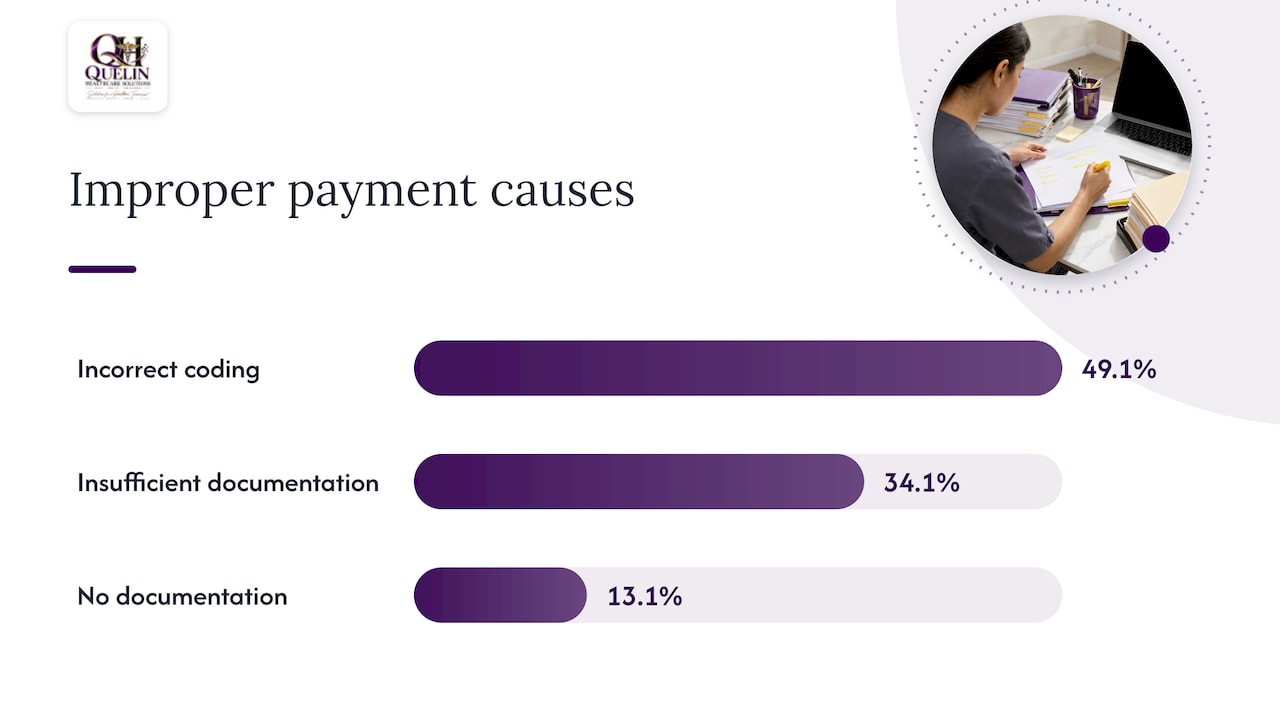
The same CMS page shows why this matters. In the 2024 Medicare fee-for-service improper payment data, E/M codes had a 10.3% improper payment rate, a projected $3.9 billion. Of those improper payments, 49.1% were due to incorrect coding, 34.1% to insufficient documentation, and 13.1% to no documentation.
A practical routine:
- Close charts promptly. The AMA's guide treats same-day chart closure as the goal, with three days acceptable.
- Match every diagnosis to the procedure it justifies, so medical necessity is visible on the claim.
- Capture every billable service. Missed charges are lost revenue, not denials, but they come from the same breakdown between chart and claim.
- Review a sample of coded encounters for each provider on a regular cycle, and feed the findings back to that provider.
Where it goes wrong: audits are skipped because nobody has time, or the person who codes also reviews their own work. Our medical coding and auditing service gives you a second, specialist set of eyes on the link between the note and the code, which is where nearly half of improper E/M payments originate.
Step 5: Scrub claims before they go out
The AHIMA best-practices article recommends resolving internal billing edits before submission and using the claims database to identify denial-prone codes. It points to public resources that show where payers and auditors are looking, including the OIG Work Plan updates, RAC focus areas, NCCI edits, AHA Coding Clinic and AMA CPT Assistant.
A pre-submission check should confirm, at minimum:
- patient demographics and insurance match the active record
- authorization number is present when required
- CPT and ICD-10 codes are linked and consistent with the note
- modifiers are correct and bundling edits are cleared
- rendering and billing provider data are complete
- the claim is going to the correct payer, in the correct order when the patient has more than one plan
The AMA's guide uses first-pass resolution as the measure here: a target of 95% of claims approved on first submission. If you are far below that, the cause is almost always upstream of the scrubber.
Step 6: Train the people who touch the claim
Education works best when it is built on your own findings. The AHIMA best-practices article recommends crafting education around what the claims database shows. That means the front desk hears about the three registration errors that cost you most, and a provider sees their own documentation pattern, not a generic webinar.
This is the loop behind the AAPC case above: analysis showed a specific documentation gap, education closed it, and a dashboard kept it closed. We offer training and education alongside billing and auditing, so what the audit finds becomes instruction for your staff.
Step 7: Measure what matters
Without numbers, prevention becomes a feeling. The AMA's physician's guide to revenue cycle management, updated in August 2025, sets these practice targets:
| Measure | AMA target |
|---|---|
| Coding accuracy | 95% |
| Patient information accuracy | 99% |
| First-pass approval of claims | 95% |
| Denial rate | Below 10% (2% to 3% is exceptional) |
| Denial appeal rate | 95% |
| Chart closure | Same day (three days acceptable) |
Track them monthly, by payer and by provider. A flat overall rate can hide one payer or one clinician that is getting worse. Our ongoing performance reporting is part of how we work with practices, so you see these trends without building the reports yourself.
Rules that change what you have to do
Prior authorization in Original Medicare
CMS's WISeR Model began on January 1, 2026 and runs through December 31, 2031. According to the WISeR provider operational guide, it requires prior authorization or pre-payment medical review for selected Original Medicare items and services in Arizona, New Jersey, Ohio, Oklahoma, Texas and Washington, for dates of service on or after January 15, 2026. Prior authorization decisions are expected within 3 calendar days, or 2 days when expedited. Associated items and services are denied if the primary service is not affirmed or is denied. If you practice in one of those states, authorization status belongs on your pre-visit checklist for the covered services.
Timely filing
The filing clock is a denial you can never appeal your way out of. Under 42 CFR §424.44, Medicare fee-for-service claims must be filed no later than the end of the period ending one calendar year after the date of service, with limited exceptions such as contractor error and retroactive entitlement. The Medicare Claims Processing Manual states that an untimely filing denial is not an initial determination and is not subject to appeal. Commercial payers set their own limits, often shorter, in your contract. Build a work queue that surfaces unbilled and unpaid claims well before the deadline.
When a claim is denied anyway
Some denials will get through. Treat each as data and as a recoverable claim.
- Read the reason and remark codes and classify the denial: front-end, coding, documentation, authorization or payer error.
- Correct and resubmit if the problem is a fixable error. Appeal if the payer's decision is wrong.
- Respect the appeal clock. For Medicare, a professional presentation summarizing the process lists redetermination within 120 days, qualified independent contractor review within 180 days, then administrative law judge review, Appeals Council review and federal court review, each within 60 days, and notes there is no penalty for appealing a claim.
- Log the cause and send it back to the team that owns it, so the denial does not repeat.
The AMA's target of a 95% appeal rate reflects a simple point: unappealed denials are revenue you have already earned and given up.
Where we fit
If your denial rate is high, your staff are spending days on rework, or you cannot say which payer and provider drive your denials, the work above is exactly what we take on. Quelin combines medical billing and RCM, coding and auditing, credentialing and payer enrollment, eligibility and prior authorization, training, and revenue integrity in one accountable service partnership, backed by structured workflows, clear communication and ongoing performance reporting.
To talk through your denial patterns and what an outsourced billing engagement would cover, contact Quelin Healthcare Solutions.
Because one team handles billing, coding, auditing and consulting, a finding in one area reaches the others. A coding audit result becomes provider education, and a recurring authorization denial becomes a front-end change.
Our perspective
Practices rarely have a denial problem. They have a handoff problem. The front desk verifies coverage, the clinician documents, the coder codes, the biller submits, and each person assumes the others caught the issue. A denial is what it looks like when nobody owned the whole path.
That is why we put billing operations, coding expertise, compliance auditing and consulting in a single service. When one partner is accountable from payer enrollment through payment follow-up, the denial reason does not stop at "resubmit." It travels back to the step that caused it, and into training for the people who can change it.
Our advice to a practice manager is to start with the data, not the symptom. Group denials by payer, code and provider, fix the largest cluster first, and report the result every month. Clean claims are the outcome of a routine kept up consistently, which is what outsourced revenue cycle work is for.
Quelin
FAQ
What is the most common reason claims are denied?
Administrative errors lead the list. Citing Optum's 2024 index, the AMA's STEPS Forward module attributes 24% of root causes to registration and eligibility, 16% to missing or invalid claim data, and 13% to authorization. Verifying coverage and authorization before each visit addresses the largest share.
What is a good claim denial rate?
The AMA's revenue cycle guide sets a denial rate below 10% as the practice target, with 2% to 3% described as exceptional. It also targets 95% of claims approved on first submission. Track the rate by payer and provider, because an average can hide one problem source.
How long do I have to appeal a denied Medicare claim?
The first level, redetermination, must be requested within 120 days. Later levels have their own windows, such as 180 days for the qualified independent contractor. A denial for untimely filing is the exception, because Medicare's manual says it is not appealable, so filing on time matters most.
Can outsourcing billing reduce denials?
It can when the partner covers the causes, not only the resubmissions: eligibility and authorization checks, credentialing, coding review, and denial trend reporting. We provide each of these services, so a practice can move that workload off its own staff.
Sources
- AMA STEPS Forward: Revenue Cycle Management Considerations
- AHIMA Journal: Best Practices for Denials Prevention and Management
- AHIMA Journal: Bringing Down Denials
- AAPC Knowledge Center: Approach Denial Management With Care
- HFMA Training and Reference Manual
- CMS: Evaluation & Management Services compliance tips
- AMA: A physician's guide to effective revenue cycle management
- CMS: WISeR Model Provider and Supplier Operational Guide
- eCFR/GovInfo: 42 CFR Part 424, Conditions for Medicare Payment
- CMS: Medicare Claims Processing Manual, Transmittal 12909
- Medicare appeals levels and deadlines, 2025 Medicare update presentation