

MIPS, the Merit-based Incentive Payment System, is the Medicare program that adjusts a clinician's Part B payments up, down or not at all based on a yearly composite score. For a dermatology practice, the score depends on which measures you pick, how clean your documentation is and whether your claims and coding tell the same story. That makes MIPS as much a billing and coding discipline as a quality program. Practices that treat it as a January data-entry task tend to leave points and payment on the table. At Quelin Healthcare Solutions, we handle medical billing, coding, auditing and revenue integrity for practices, and this guide covers what a dermatology manager or owner needs to know to run MIPS well.
TL;DR
- MIPS applies a positive, negative or neutral payment adjustment, in a budget-neutral manner, based on a composite score from four categories: Quality, Promoting Interoperability, Improvement Activities and Cost.
- Whether you must report depends on Medicare volume, not specialty. Check your status for each clinician and for the group.
- Dermatology has its own measure choices and a dermatology MIPS Value Pathway (MVP), which is optional for now.
- CMS has proposed moving clinicians toward MVPs and ending traditional MIPS reporting beginning with the 2029 performance year. These are proposals, so watch the final rule.
- Most lost points come from documentation and data errors that a coding and audit review can catch before submission.
Table of Contents
- What MIPS means for a dermatology practice
- Are you required to report?
- How the score is built
- Three ways to report
- What is changing
- Where dermatology practices lose points
- How Quelin supports a dermatology practice
- Our perspective
- FAQ
- Sources
What MIPS means for a dermatology practice
MIPS was created under MACRA, the law that reshaped how Medicare pays clinicians. CMS describes it as a system in which each eligible clinician receives a positive, negative or neutral payment adjustment, applied in a budget-neutral way, based on a composite performance score. Budget-neutral means the bonuses are funded in part by the penalties. Your score is therefore measured against the rest of the field as well as against a standard.
Dermatology has a few features that shape the program:
- Many dermatology services are procedural (biopsies, excisions, Mohs surgery), so documentation and pathology timing feed directly into quality measures.
- Practices are often small or independent, with limited staff for reporting.
- Specialty measures exist, but they are a narrower menu than primary care has. CMS itself noted in 2016 that dermatology had fewer than 10 measures in the older preferred measure sets, which is part of why specialty sets and a dermatology MVP were developed later.
Are you required to report?
Participation is set by Medicare billing volume and clinician type. MIPS-eligible clinicians include physicians, physician assistants, nurse practitioners, clinical nurse specialists and certified registered nurse anesthetists, according to the Mohs College's MIPS guidance. That means the PAs and NPs in your dermatology office count too.
Exemptions come from three places:
- New to Medicare. Clinicians newly enrolled during a performance period are exempt until the following period.
- Low volume. For 2025, the American College of Physicians summarizes the threshold this way: to be required, a clinician must exceed $90,000 in Medicare Part B covered professional services, see more than 200 Part B patients and provide more than 200 covered services. Thresholds have changed over the years, so confirm the current figures for your performance year on the CMS Quality Payment Program site.
- Qualifying APM participants. Clinicians who meet the bar in an advanced alternative payment model are excluded.
Status is calculated per clinician and practice association (the NPI and TIN combination), and for a group collectively. A common mistake is assuming the whole practice shares one status. A newly hired associate, a part-time PA or a clinician working at two practices can each land differently. Pull each clinician's status from the QPP participation lookup and record it before you plan anything else.
How the score is built
The composite score combines four categories. The ACP's summary of the current weights is:
| Category | Weight | What it asks for |
|---|---|---|
| Quality | 30% | At least six measures, including an outcome or high-priority measure, or a complete specialty measure set |
| Promoting Interoperability | 25% | Certified EHR data for at least 180 continuous days |
| Improvement Activities | 15% | A minimum continuous 90-day period; unweighted beginning in 2025 |
| Cost | 30% | Calculated by CMS from claims; you do not submit it |
The Cost category is worth noting because you do not report it. CMS draws it from your Medicare claims, so claim accuracy and coding choices influence it without any extra submission. This is where billing quality and MIPS meet.
Quality: the category you can shape most
The American Academy of Dermatology publishes its 2025 quality measures list. Measures dermatologists commonly consider include:
- MIPS 397: Melanoma Reporting
- MIPS 410: Psoriasis, Clinical Response to Systemic Medications
- MIPS 440: Skin Cancer, Biopsy Reporting Time (Pathologist to Clinician)
- MIPS 485 and 486: patient-reported itch severity in psoriasis and dermatitis
- MIPS 509: Melanoma, Tracking and Evaluation of Recurrence
- QCDR measures such as AAD 12 (Melanoma: Appropriate Surgical Margins) and AAD 15 (Psoriasis: Appropriate Assessment and Treatment of Severe Psoriasis)
A QCDR is a qualified clinical data registry, an approved organization that can submit its own measures on your behalf.
Pick measures by asking three questions. Does the practice see enough eligible patients to build a meaningful sample? Can the EHR capture the required data without manual workarounds? And is the work already happening, so the measure documents care rather than adds tasks? Measure 440, for instance, is submitted each time a biopsy is performed, so a practice with high biopsy volume gets a large denominator, and any gap in pathology report tracking shows up everywhere.
Promoting Interoperability
This category rests on your certified EHR. CMS's 2026 quick start guide calls for a continuous 180-day period in the calendar year, with six to seven required measures plus attestations. It also describes a hardship exception for situations such as a decertified EHR, insufficient internet or extreme circumstances. The application deadline falls at the end of the performance year, so check the QPP site early if you think you might qualify.
Improvement Activities
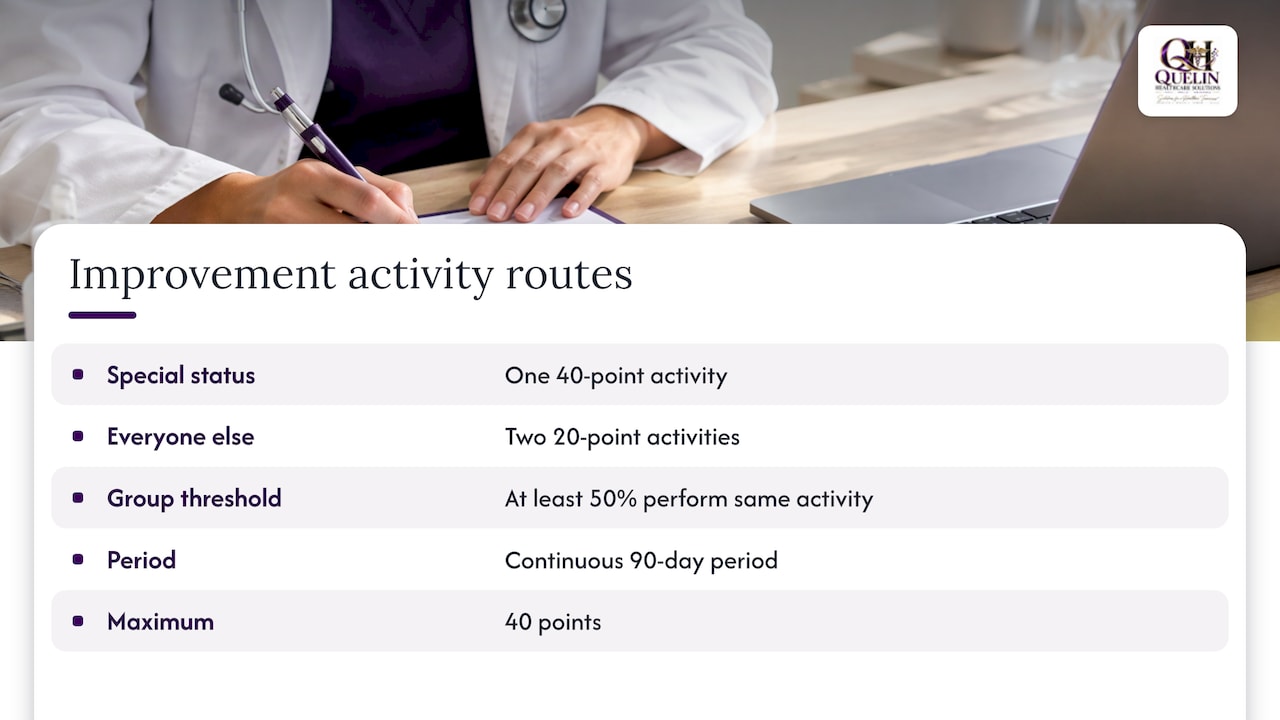
For 2026, CMS requires one activity worth 40 points for clinicians with small practice, rural, non-patient-facing or HPSA special status, and two activities worth 20 points each for everyone else, with a 40-point maximum. A group can attest when at least 50% of its clinicians perform the same activity during a continuous 90-day period. Document who did what and when. A bare attestation with no records behind it is the weak point in an audit.
Three ways to report
CMS's guide lists three reporting options: Traditional MIPS, MIPS Value Pathways and the APM Performance Pathway. Most independent dermatology practices choose between the first two.
Traditional MIPS lets you assemble your own measures and activities. It offers flexibility, and it is the path most practices know.
MVPs group measures and activities around a specialty or condition. The ACP notes CMS finalized six MVPs beginning with the 2025 performance period, with dermatology among them, and designed them to align the four categories and reduce reporting burden. They remain optional for now. Registration for MVPs has opened in the spring in recent years, so look for the registration window on the QPP site before your performance year closes in on you.
The data submission window follows a pattern: it opens in early January after the performance year and closes on March 31. Confirm the exact dates on the QPP site each year.
Registries
Many dermatologists report through the AAD's DataDerm registry. The AAD says DataDerm has been dermatology's largest clinical data registry since 2016, supports MIPS reporting across Quality, Improvement Activities and Promoting Interoperability, and lets AAD-member dermatologists submit data at no cost, with an annual fee per clinician who reports MIPS through it. Whichever route you use, the registry only reports what your records contain. The accuracy of the underlying documentation is still your responsibility.
What is changing
CMS's CY 2027 Physician Fee Schedule proposal, published in the Federal Register on July 16, 2026, would:
- require reporting of MIPS core measures, with self-attestation
- exempt small practices from the core measure reporting requirement
- remove the high-priority measure designation
- use alternative data sources to determine eligibility for the automatic under-utilization exception
Law firm Holland & Knight's analysis of the proposal adds that CMS proposed to sunset traditional MIPS beginning with the 2029 performance year and make MVPs the primary framework. It also notes that large multispecialty practices cannot participate in MVPs as a group and would need to form subgroups sharing a clinical focus.
These are proposals. Final rules typically arrive in the fall, and details can shift. The practical reading for a dermatology practice is that an MVP-ready workflow will matter more each year. Practices that start learning the dermatology MVP now, while it is optional, will avoid a scramble later.
The proposal also affects payment rates more broadly. Holland & Knight reports the proposed 2027 conversion factor would fall to $33.1693 for qualifying APM participants and $32.8409 for nonqualifying participants, after a temporary 2.5% statutory increase expires at the end of 2026. The MIPS adjustment sits on top of that base rate, so a clean MIPS result matters more when the base rate tightens.
Where dermatology practices lose points
The errors that cost practices are rarely about clinical care. They are administrative:
- Wrong status assumptions. Reporting for a clinician who is exempt wastes effort, and missing one who is required risks an adjustment.
- Measures chosen without checking volume. A measure that looks attractive but has few eligible patients produces a thin or unscorable result.
- Documentation gaps. If the note does not support the measure action, the data fails an audit even when the care was delivered.
- Coding that does not match the chart. Biopsy, excision and Mohs coding errors create both denials and inconsistent quality data.
- Late discovery. Waiting until the March window leaves no time to fix a six-month-old problem. The 180-day and 90-day periods mean most of the work is done during the year.
A practical rhythm helps. Each quarter, pull a measure-level report from your EHR or registry, compare it with the prior quarter, and sample a set of charts against the measure specifications. Each fall, review your final feedback and targeted review options. CMS has made performance feedback and final scores available in the fall following the performance year, and the targeted review process is the route to question a score you believe is wrong.
How Quelin supports a dermatology practice
MIPS performance depends on the same things that drive clean revenue: accurate coding, complete documentation, eligibility checked up front and denials understood and fixed. Our services cover medical billing and revenue cycle management, medical coding and auditing, eligibility and prior authorization, credentialing and payer enrollment, revenue integrity, staff training and practice operations consulting, all in one accountable partnership with structured workflows and ongoing performance reporting.
For a dermatology practice, that means coding and documentation review on biopsy, excision and Mohs encounters, training for front-desk and clinical staff on what the chart must show, and consulting on the operational routines that keep a measure workflow running through the year. If you want a second set of eyes on your claims and documentation before your next reporting period, talk with Quelin about your practice.
Our perspective
Most dermatology practices we talk about MIPS with describe it the same way: a separate chore that lands on someone's desk in the first quarter. We see it differently. The measures, the claims and the chart are one record, and MIPS is a test of whether that record is consistent.
That is why we put billing, coding, auditing and consulting in one service. A coding audit finds the documentation gaps that would cost quality points. A denial review shows which workflows are leaking. Staff training makes the fix stick after the audit is done. When one partner is accountable for all of it, with clear communication and regular performance reporting, the practice stops managing three or four separate problems.
With CMS signaling a move toward MVPs, the practices that benefit will be those with disciplined documentation and operations. Our view is that this discipline is built across the year, not in March.
Quelin
FAQ
What is MIPS in dermatology terms?
MIPS is the Medicare program that scores eligible clinicians on Quality, Promoting Interoperability, Improvement Activities and Cost, then applies a positive, negative or neutral payment adjustment. Dermatologists, along with the PAs and NPs in their practices, are covered if they meet the Medicare volume thresholds. Dermatology has its own measure choices and an optional MVP.
Does MIPS still exist?
Yes. CMS's CY 2027 proposed rule would keep MIPS while moving clinicians toward MVPs and ending traditional MIPS reporting beginning with the 2029 performance year, according to Holland & Knight's summary. That is a proposal, so watch for the final rule.
What is the MIPS penalty?
The adjustment can be positive, negative or neutral and is applied in a budget-neutral manner, per CMS. The size of a given year's adjustment depends on the final scores across all clinicians, so use the CMS Quality Payment Program site for the figure that applies to your performance year.
How do I know if my practice has to report?
Check each clinician's status on the QPP site. Eligibility turns on new Medicare enrollment, the low-volume thresholds and qualifying APM participation, and it is calculated per clinician and practice association and for the group as a whole.
When is the data submission window?
Submission follows the performance year, opening in early January and closing March 31, per CMS's quick start guide. Confirm the exact dates on the QPP site for your year.
Sources
- CMS Quality Measure Development Plan
- CMS MIPS Participation Fact Sheet
- MIPS for Mohs, American College of Mohs Surgery
- Merit-Based Incentive Payment System, ACP Online
- 2025 quality measures for MIPS reporting, AAD
- 2026 MIPS Promoting Interoperability Quick Start Guide, CMS
- Improvement Activities: Traditional MIPS Requirements, QPP
- About DataDerm, AAD
- Federal Register, CY 2027 Physician Fee Schedule proposed rule
- CMS Issues CY 2027 Medicare Physician Fee Schedule Proposed Rule, Holland & Knight
- Dermatology World Weekly, AAD