

The medical billing process is the chain of tasks that turns a patient visit into payment: registering the patient, verifying coverage, documenting and coding the care, submitting a claim, working the payer's response, and collecting any balance. Most revenue is lost not at the end of that chain but at the start, when a registration or eligibility error travels silently into every later step. That is why practices that hand billing, coding, eligibility and credentialing to one accountable team, as we do at Quelin Healthcare Solutions, tend to see fewer surprises downstream.
This guide walks through each step, who owns it, where it breaks, and what to measure.
TL;DR
- The AMA's revenue cycle guide describes three phases (front end, mid cycle, back end) and nine steps, from registration to collections.
- HFMA reports that 90% of denied claims are preventable and about half start with eligibility, registration or authorization errors.
- Medicare claims must reach the MAC within one calendar year of the date of service, and a claim denied for timely filing cannot be appealed.
- Track a short set of numbers: clean claim rate, initial denial rate, days in A/R and denial resolution time.
Table of Contents
- The medical billing cycle at a glance
- Front end: where clean claims begin
- Mid cycle: documentation, coding and claim submission
- Back end: payment, denials and patient balances
- Why denials are mostly a front-end problem
- Numbers to track
- Where outsourcing fits
- Our perspective
- FAQ
- Sources
The medical billing cycle at a glance
The AMA guide says the cycle spans three phases that can be summarized in nine steps. Here is how they line up.
| Phase | Step | Typical owner |
|---|---|---|
| Front end | 1. Patient registration | Front desk, scheduling |
| Front end | 2. Insurance verification and authorization | Front desk or billing team |
| Front end | 3. Check-in and check-out, point-of-service collection | Front desk |
| Mid cycle | 4. Patient visit and documentation | Clinician |
| Mid cycle | 5. Coding, charge capture and compliance review | Coders, auditors |
| Mid cycle | 6. Claim preparation and submission | Billers |
| Back end | 7. Claim monitoring and payer remittance | Billers, payment posters |
| Back end | 8. Denials management and appeals | Denial specialists |
| Back end | 9. Patient statements, payments and collections | Billing office |
The Healthcare Financial Management Association (HFMA) defines revenue cycle management as tracking revenue from the first appointment through final payment of the balance, including all communication with patients, insurers and government payers such as Medicare and Medicaid. Billing is one thread in that larger cycle, and every thread has to hold.
Front end: where clean claims begin
HFMA's Emerging Leaders Summit material (November 2026) puts it bluntly: registration is the claim's DNA, because every downstream step inherits what is entered there. The same material notes that a $10 mistake on the front end can cost $100 to fix on the back end.
Step 1: Patient registration
Staff capture contact details, demographics and medical history by phone, through a patient portal or in person, according to the AMA guide. Insurance card details are collected here too.
Where it goes wrong: misspelled names, transposed birth dates, outdated member IDs, and a missing secondary insurer. Each one produces a rejection or denial weeks later, long after anyone remembers the patient.
Step 2: Insurance verification and prior authorization
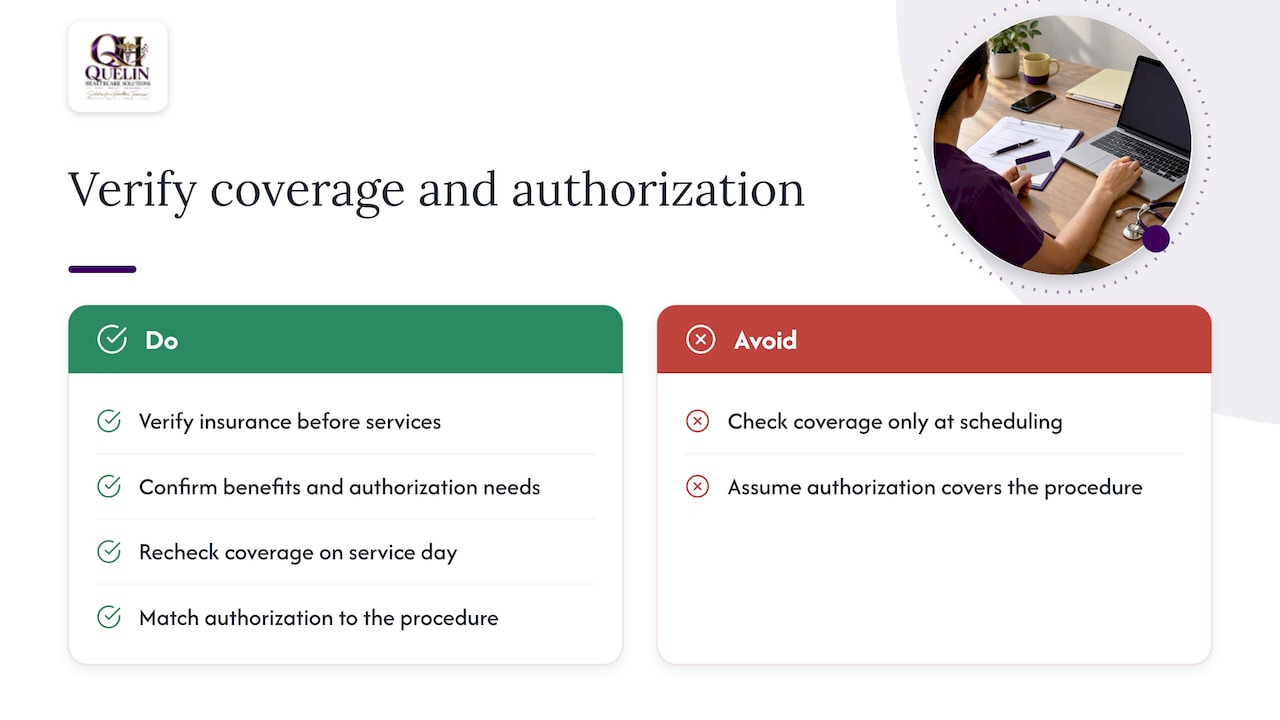
The AMA guide says staff should confirm current coverage, check for secondary insurance exceptions and ask whether exams, tests or procedures need prior authorization. HFMA's 2024 CPAR training manual recommends verifying insurance for all patients before services (emergency cases under EMTALA are the exception), confirming benefit levels, network status, deductibles and copays, effective dates and authorization requirements.
Where it goes wrong: checking coverage once at scheduling and never again on the day of service, or assuming an authorization on file covers the exact procedure performed. A clean, well-coded claim can still be denied for a missing or mismatched authorization, and that is hard to repair after the service has been delivered.
This is a step we take off practices' plates: our Eligibility and Prior Authorization service handles verification and authorizations so your front desk is not chasing payer portals between patients.
Step 3: Check-in, check-out and point-of-service collection
At check-in the front desk confirms the information on file and collects copays; at check-out it schedules follow-ups and collects any balance known at that point. Estimates matter here. For uninsured and self-pay patients, federal rules require a good faith estimate when the service is scheduled at least 3 business days ahead, or on request, listing expected items, services, diagnosis codes and charges.
Credentialing sits underneath all three steps
None of this pays if the provider is not enrolled with the payer. Under 42 CFR Part 424 Subpart P, providers and suppliers (except privately contracted physicians) must meet and maintain Medicare enrollment, revalidation and update requirements to bill the program, and CMS may deny enrollment for noncompliance. Commercial payers run their own enrollment. Our Credentialing and Payer Enrollment service covers this groundwork, so a new provider is not seeing patients whose claims cannot be paid.
Mid cycle: documentation, coding and claim submission
The USC Schaeffer Center explains that providers are not automatically reimbursed for care. Payment depends on how accurately care is documented and communicated, and excellent clinical care can be delayed or denied if documentation is incomplete, coding is inaccurate or the service does not meet coverage requirements.
Step 4: The visit and its documentation
The AMA guide is direct: care that is not documented cannot be billed. The note has to support the level of service, the diagnoses and the medical necessity of what was done.
Step 5: Coding, charge capture and compliance review
Coders translate the encounter into CPT, HCPCS and ICD-10 codes. The AMA guide says coding staff must make sure documentation and codes agree and query the clinician when they do not. Charge capture belongs here too: a procedure that never reaches the charge sheet is revenue that never reaches the claim.
Where it goes wrong: codes chosen from habit rather than the note, missed modifiers, and bundling errors. Our Medical Coding and Auditing service pairs coding with compliance-oriented review, and our Revenue Integrity service looks at whether what was documented, coded and billed lines up.
Step 6: Claim preparation and submission
The claim is built, scrubbed (checked against payer edits) and sent, usually through a clearinghouse. CMS says the 837P electronic format (version 5010A1) is the current standard for professional claims, while the CMS-1500 is the standard paper form for non-institutional providers, allowed under limited exceptions.
Timing rules matter. Medicare claims must be filed with the MAC no later than one calendar year after the date of service, and a claim denied for timely filing is not an initial determination, so it cannot be appealed. Medicare fee-for-service claims go to the MAC for the state where the service was provided; Medicare Advantage claims go to the patient's plan. Providers cannot charge patients for completing or filing a claim.
The AMA STEPS Forward module notes that claim submission has upwards of 20 separate components and that delays can postpone payment for several months, which is why daily checkpoints pay off.
Back end: payment, denials and patient balances
Step 7: Monitoring claims and posting payments
A rejected claim stops at the scrubber or clearinghouse and never reaches adjudication. A denial comes from the payer after adjudication. Keeping those two apart tells you who to fix: your edits, or your front end.
Payment posting compares three things: the contracted rate, the electronic remittance advice (the 835) and the actual bank deposit. That comparison, described in the HFMA summit deck, catches underpayments, coded denials and misapplied deposits.
Follow-up is more than a monthly status call. HFMA's CPAR manual describes proper follow-up as gathering information, pressing for details, forcing proper handling and documenting every action, before and after a claim or appeal is submitted.
HFMA's A/R tiers give a practical rhythm:
- 0 to 30 days: monitor.
- 31 to 60 days: check status.
- 61 to 90 days: escalate.
- Over 90 days: management review.
Step 8: Denials management and appeals
The AMA STEPS Forward module reports that unresolved denials cost the average practice about $5 million a year, almost 5% of net patient revenue, and that average initial denial rates rose from 9% in 2016 to 12% by early 2022. It lists the most common reasons, per the Medical Group Management Association:
- Prior authorization not obtained
- Missing or incorrect information
- Medical necessity not met
- Procedure not covered
- Provider out of network
- Duplicate claims
- Coordination of benefits problems
- Bundling
- Timely filing limit missed
Denial codes fall into five groups: contractual obligations (CO), other adjustments (OA), corrections and reversals (CR), payer-initiated reductions (PI) and patient responsibility (PR).
Sorting denials speeds the work. HFMA separates clinical denials (coverage or medical necessity problems) from technical ones (untimely filing, wrong demographics, a missing authorization number). It also separates soft denials, which need more information or a resubmission, from hard denials, which need an appeal, and partial denials, which hit single line items.
The AMA's position is that most, if not all, denials should be appealed: practices cannot control what payers deny, but they can control how they respond.
For Medicare, the claims processing manual sets five appeal levels:
| Level | Deadline to request |
|---|---|
| Redetermination by the MAC | 120 days from receipt of the initial determination notice |
| QIC reconsideration | 180 days from the redetermination |
| ALJ hearing | 60 days |
| Appeals Council review | 60 days |
| Federal court review | 60 days |
Receipt is presumed 5 days after the notice date. Good cause can extend a deadline, but the manual states that a billing company's failure to file on time is not good cause. Whoever handles your billing, deadlines have to be tracked by someone who owns them.
Out-of-network disputes follow a separate track. Under the No Surprises Act, plans must send an initial payment or denial notice to a nonparticipating provider within 30 calendar days of receiving a bill, and open negotiation runs for 30 business days after that notice, per the Departments' FAQs, before federal IDR can begin.
Step 9: Patient statements and collections
Once insurance has paid, the remaining balance moves to the patient. The USC Schaeffer piece notes that patients may get several bills from separately billing organizations, plus explanation-of-benefits notices arriving over months. Clear statements, a named contact and payment options reduce the confusion that turns a balance into a bad debt.
Why denials are mostly a front-end problem
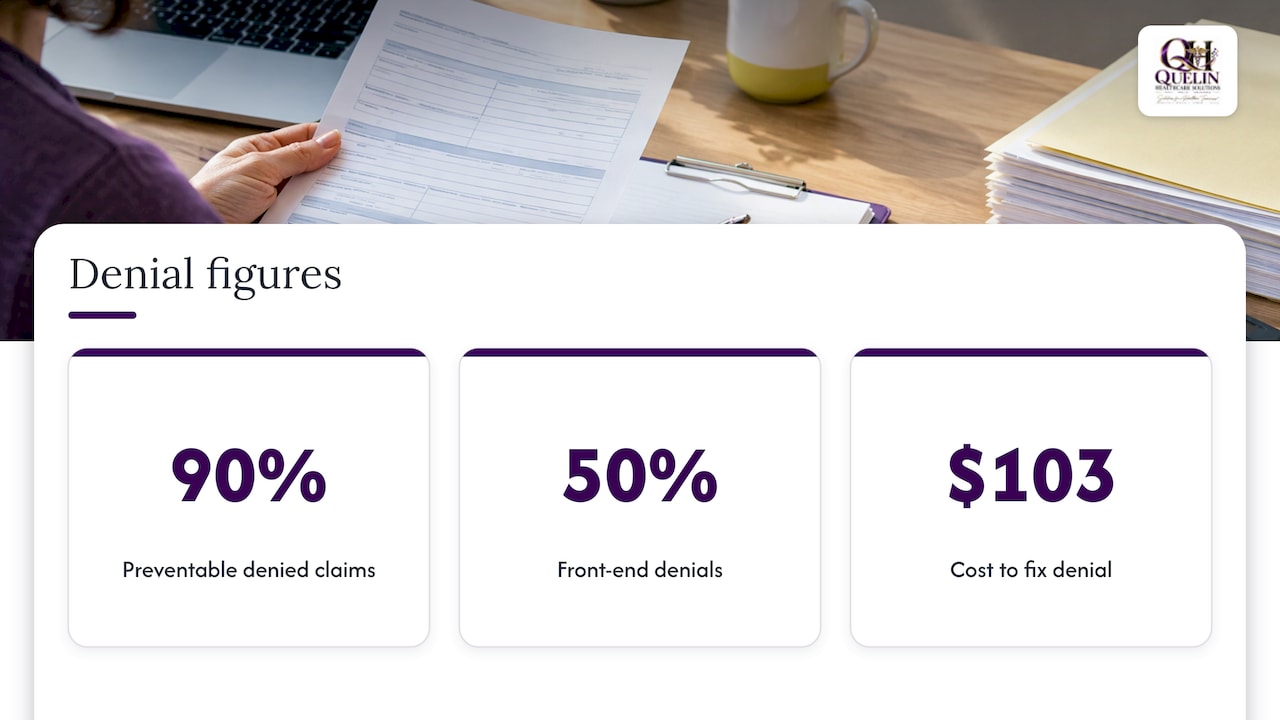
HFMA's Fall 2025 presentation reports that 90% of denied claims are preventable, cites a finding that 50% of denials come from front-end breakdowns in eligibility, registration and authorizations, and puts the national average cost to fix one denied claim at $103. Its recommended remedies are real-time eligibility checks, authorization validation, accurate demographics and front-end scrubbing.
That matches HFMA's wider point that denials management is shifting from after-the-fact appeals toward prevention, and the AMA's advice to make staff training the first line of defense, give each denial a clear owner and review the workflow whenever payers change rules.
Numbers to track
HFMA's benchmarks, from the same Fall 2025 presentation, give you targets for a monthly dashboard:
| Measure | Benchmark |
|---|---|
| Initial denial rate | Under 5% |
| Clean claim rate | 98% or higher |
| Denial write-off | Under 2% of net patient revenue |
| Denial resolution time | Under 30 days |
| Denial overturn rate | Over 60% |
Compare your own payer reports against these, and break denials down by payer, reason code and the staff step where the error began. A pattern by reason code almost always points to one fixable upstream habit.
Where outsourcing fits
A practice can run every step in house, but the steps depend on one another: a registration slip, a coding gap and a missed appeal deadline are all one revenue problem that lands in three different job descriptions. Independent practices and multi-specialty clinics often find that the cycle works best when one team is accountable from enrollment to collections.
Our medical billing and revenue cycle services cover medical billing and RCM, coding and auditing, credentialing and payer enrollment, eligibility and prior authorization, virtual assistant and admin support, training and education, practice operations consulting and revenue integrity. Pricing is not published, so the way to find out what your cycle would look like is to start a conversation about your specialty and payer mix.
Our perspective
Most practices we talk with describe their billing problem as a collections problem. The workflow usually says otherwise. Eligibility, documentation, coding and follow-up are four handoffs, and a claim only pays if all four hold.
That is why we combine billing operations, coding expertise, compliance auditing and consulting in one accountable partnership, backed by structured workflows, clear communication, practical training and ongoing performance reporting. When the same team sees the registration screen, the coded note and the remittance, a denial stops being a mystery and becomes a pattern we can trace and fix.
The AMA says optimal revenue cycle management is collaborative, with each player understanding their role in the whole cycle. We build our service around that idea: your clinicians keep their focus on care, and your administrators get fewer fires to put out.
Quelin
FAQ
How long does the medical billing process take?
It varies by payer, specialty and claim quality. A clean claim can be paid quickly, while a claim with errors can sit in rework for months. The AMA notes that delays in claim submission alone can postpone payment by several months, which is why submitting daily and monitoring status matters.
What is the difference between a rejected claim and a denied claim?
A rejected claim is stopped at the scrubber or clearinghouse for a formatting or data error and never reaches the payer's adjudication. A denied claim is processed by the payer and refused in whole or part. Rejections are corrected and resubmitted; denials may need an appeal.
Who is responsible for each step of medical billing?
Front-desk staff typically own registration, verification and point-of-service collection. Clinicians own documentation, coders own code assignment, and billers own submission, follow-up and payment posting. Denials and patient collections usually belong to the back-office team, or to an outsourced billing partner that covers the whole cycle.
What is the deadline to file a Medicare claim?
Medicare claims must be filed with the MAC within one calendar year of the date of service, according to CMS. A claim denied for missing that limit cannot be appealed, so tracking filing windows is essential. Other payers set their own limits in their contracts.
Sources
- A physician's guide to effective revenue cycle management (AMA)
- Healthcare Revenue Cycle Management (HFMA)
- CPAR Training and Reference Manual 2024 (HFMA)
- From Registration to Reimbursement, Fall 2025 (HFMA)
- Emerging Leaders Summit deck, November 2026 (HFMA)
- Revenue Cycle Management Considerations (AMA STEPS Forward)
- The Hidden Infrastructure of Medical Billing (USC Schaeffer)
- MLN006976: Medicare Billing, CMS-1500 and 837P (CMS)
- Medicare Claims Processing Manual, Chapter 29 (CMS)
- 42 CFR Part 424 Subpart P (eCFR)
- Good Faith Estimate FAQs Part 4 (CMS)
- FAQs About Consolidated Appropriations Act, 2021 Implementation Part 69 (DOL)