

An insufficient documentation denial means the payer reviewed your medical record and could not find enough in it to support the service you billed. The fix is rarely a better appeal letter. It is a record that proves what happened, why it was necessary and who did it, plus a billing routine that catches gaps before a claim leaves your office. That is the work Quelin does for practices: billing, coding and auditing handled together, so the person who finds the gap and the person who fixes it are in the same conversation.
- ✓Medical billing
- ✓Coding
- ✓Auditing
- ✓Revenue cycle management
TL;DR
- Insufficient documentation means the record does not support payment: the reviewer cannot tell that the service was provided, was provided at the level billed, or was medically necessary, or a required element such as a signature is missing.
- Common triggers are thin progress notes, missing signatures, and missing orders. Diagnosis codes alone are not enough support.
- Response windows are short. Medicare contractors give 45 calendar days for most additional documentation requests and 30 for UPIC requests.
- Prevention is a loop: written policies, random chart audits, denial tracking, root-cause analysis, staff education and re-audits.
- Many denials are fixable, so tracking and appealing them pays.
Table of Contents
- What the term means in practice
- Why it matters financially
- What typically triggers it
- What a defensible encounter note contains
- What to do when the denial arrives
- Preventing repeat denials
- Why one team for billing, coding and audits
- How Quelin can help
- FAQ
- Sources
What the term means in practice
Medicare's Comprehensive Error Rate Testing (CERT) program is the audit that measures how often Medicare pays claims wrongly. CMS says its reviewers record an insufficient documentation error when the submitted records do not support payment because they cannot determine whether services were provided, were provided at the level billed, or were medically necessary. The same label applies when a required element is missing, such as a physician signature on an order or a form that is not fully completed.
Note the difference from "no documentation," which CERT counts separately. Insufficient means you responded, but what you sent did not carry the claim.
Commercial payers and Medicaid plans use their own wording, such as "records do not support," "medical necessity not established" or "additional information required." The underlying question is the same: does the chart prove the claim?
Why it matters financially
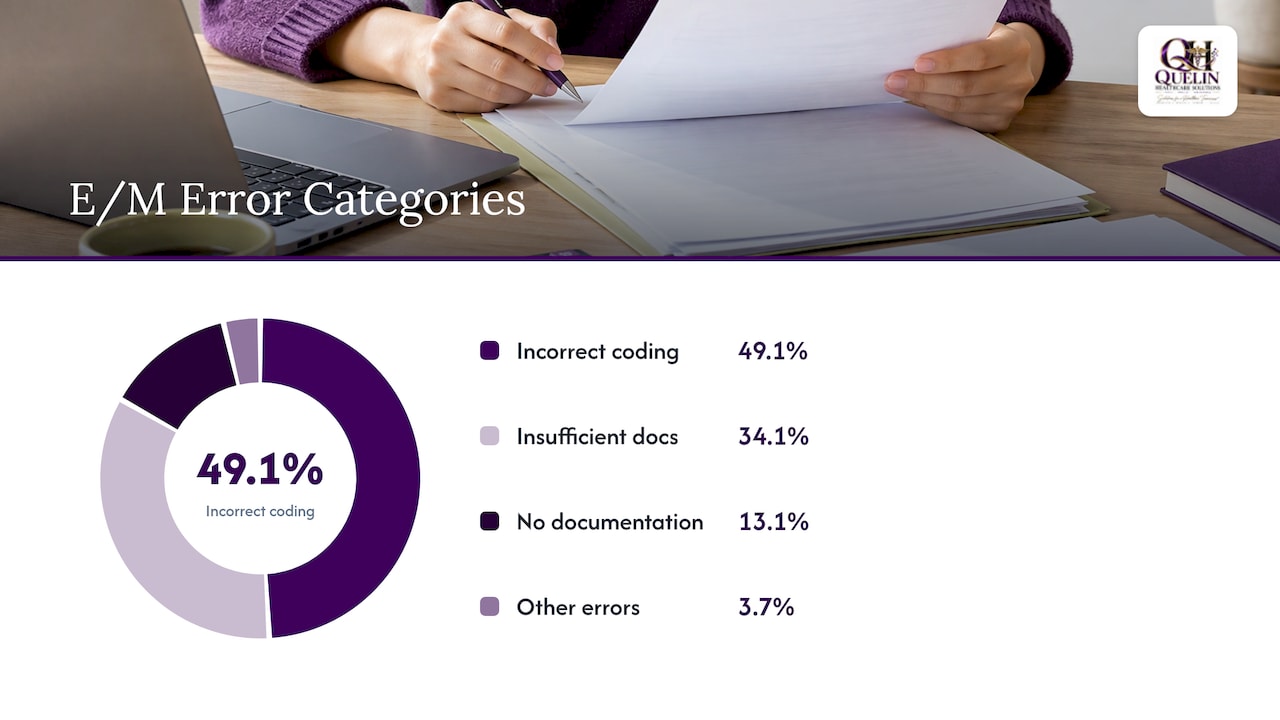
The scale is large. In CMS's 2024 improper payment data for evaluation and management (E/M) services, E/M codes had a 10.3% improper payment rate, a projected $3.9 billion. Of those errors, incorrect coding was 49.1%, insufficient documentation 34.1%, no documentation 13.1% and other errors 3.7%. For E/M, then, a third of the problem sits in the chart, and nearly half sits in coding. The two cannot be fixed separately.
There is also a recovery risk. CMS says it can deny payment for services with incomplete or illegible records, and where claims were already paid without sufficient documentation, CMS may treat the payment as an overpayment and recover part or all of it. A weak note can cost you money months after you were paid.
And many denials are not final. In a 2022 HHS OIG review of prior authorization denials by large Medicare Advantage organizations in one week of 2019, 13 percent met Medicare coverage rules. A common cause was a plan saying documentation was lacking when the existing records were sufficient. OIG testimony also reported that when denials were appealed, plans overturned 75 percent of them in 2014 to 2016, while only 1 percent of denials were appealed. Those figures concern Medicare Advantage, but they make the practical point: a denial worked properly is often recoverable, and an unworked one is lost revenue.
What typically triggers it
CMS names three frequent causes: progress notes that lack the detail needed to support coverage requirements, records that fail signature requirements, and missing documentation of an order when Medicare policy requires one.
CERT special studies show how specific this gets. In CMS's January 2017 compliance newsletter, most improper payments for retinal photocoagulation and facet joint injections were due to insufficient documentation. Findings included missing procedure notes, no intent to order tests, no diagnostic test results, no signature log or attestation, and no record that the patient failed conservative treatment as the local coverage determination (LCD) required. An LCD is a regional Medicare contractor's rule on when it covers a service.
A Medicare contractor's list of common CERT errors adds more:
| Claim type | Typical insufficient documentation finding |
|---|---|
| Ambulance | Missing or illegible signature, no attestation or signature log, no support that another transport method was unsafe |
| E/M visits | Missing signed and dated order, documentation that supports only a lower level than billed, missing signed note for the date of service, diagnosis codes offered as the only support |
The pattern: the care may well have happened, but the record does not show it in the way the policy asks.
What a defensible encounter note contains
CMS's E/M guidance says each encounter note should include:
- the reason for the encounter and relevant history
- physical exam findings and prior diagnostic test results
- an assessment or diagnosis
- the rationale for ordering diagnostic and ancillary services
- a plan of care
- the date of service and the legible identity of the observer
- documentation that supports the CPT, HCPCS and ICD-10-CM codes on the claim
That list is from CMS's E/M compliance tips. For Medicaid, CMS's documentation fact sheet adds general rules: medical necessity and rationale must be documented in the record, entries must be legible, signed and dated, records are never altered, and overpayments must be returned within 60 days.
Signatures and attestations
Signature rules were softened in recent CMS guidance. Program Integrity Manual Transmittal R13008, effective January 17, 2025, says contractors must consider the totality of the medical record for signature compliance. They may use an attestation or signature log to resolve missing or illegible signatures when a signature is not required to precede an event. It also says certificates of medical necessity, supplier statements and physician attestations by themselves do not establish medical necessity, even when signed by the ordering physician.
The same transmittal states that when a contractor asks for an attestation or log, the billing entity gets 20 calendar days to submit it. A valid attestation is signed and dated by the author of the entry and identifies the beneficiary. Scribes need not sign notes, but the treating physician's or non-physician practitioner's signature affirming the note is required, including when AI technology captures the transcription.
Payer-specific rules
Commercial plans can be stricter. One Blue plan's 2025 provider manual expects documentation at the time of service or within a reasonable time such as 24 to 48 hours, says cloned or boilerplate records from earlier visits are not billable, and requires start time and total time for each time-based service. Every payer contract in your mix deserves a read for this kind of rule.
What to do when the denial arrives
- Read the exact reason. Pull the remittance advice and the denial code and remark code. "Insufficient documentation" can mean a missing order, a missing signature, an unsupported level of service or a medical necessity gap. Each has a different fix.
- Calendar the deadline the same day. CMS's additional documentation request guidance gives providers 45 calendar days to respond to requests from Medicare administrative contractors, supplemental medical review contractors and recovery audit contractors, and 30 days for UPIC requests. Late documentation may be accepted for good cause, such as a natural disaster. If you do not respond in time, the contractor has authority to deny the claim.
- Compare the record to the policy. Check the national or local coverage rule behind the service, and confirm each required element exists in the chart.
- Decide: corrected claim or appeal. A Medicare contractor's appeal guide says redetermination requests should include documentation related to the denial reason plus new information, and previously submitted records need not be resent. For LCD denials, a corrected billing statement must accompany the pertinent records. Unprocessable claim rejections coded MA130 have no appeal rights and need a new corrected claim.
- Send a complete, organized packet. Label pages, include signature attestations where appropriate, and tie each document to the policy element it satisfies.
- Log the cause. Every denial is data for the prevention loop below.
The weak point in this routine is usually capacity, not knowledge. Deadlines run while staff handle the front desk, and denials sit unworked. Quelin's denial management, coding and auditing services exist to take this work off a practice's plate.
Preventing repeat denials
CMS's Medicaid education material lays out a practical loop: written policies aligned with State rules and the CPT Manual, periodic random-sample chart audits by staff who understand documentation, coding and billing, tracking of remittance denials, trend analysis, and a corrective action plan. That plan names the problem, the root cause, the corrective and preventive actions, the implementation, staff education and a re-audit. The material is blunt that an audit without corrective action and staff education has no point.

CMS's acceptable corrective action responses for documents absent from a record show why root cause matters. Staff turnover causing missed progress notes is a different problem from a practice not keeping required documentation. Corrective actions include staff education, recoupment of affected claims and follow-up audits every three months. If errors persist after two audits, the case may be referred to a program integrity unit and the provider may face a Corporate Integrity Agreement.
A simple monthly routine
- Pull a random sample of charts for each provider and each high-volume code.
- Check each against the payer policy and the encounter note elements above.
- Compare findings with your denial log, grouped by payer, code and reason.
- Fix the cause, whether template, workflow or training, then re-audit.
Watch your templates
R13008 also notes that limited-space templates built around reimbursement are discouraged, because claim review experience shows they often fail to capture enough clinical detail. Templates that auto-fill history from prior visits create the cloning risk payers penalize.
Why one team for billing, coding and audits
The E/M numbers show that coding and documentation errors travel together. A coder who sees a thin note cannot legitimately code up. A biller who sees the same denial pattern week after week cannot fix a template. Splitting those jobs across vendors, or between a billing company and an overloaded front office, leaves the loop open.
What we offer is built to close it. Quelin combines billing operations, coding expertise, compliance auditing and consulting in a single accountable service partnership, with structured workflows, clear communication, practical training and ongoing performance reporting. For an insufficient documentation problem, that means the denial, the coding, the audit finding and the staff training sit under one roof.
Our perspective
Most insufficient documentation denials we would expect a practice to see are not a mystery. They come from a handful of repeat causes: a missing signature process, notes that do not show why a service was necessary, or a level of service that outruns the note.
The fix is a loop, not a one-off appeal. Audit a sample, find the root cause, educate the provider or staff, and audit again. That is why we pair coding, auditing, training and billing operations in one service: each finding feeds the next claim.
Practices with high denial rates do not need more paperwork. They need someone accountable for the whole path from payer enrollment to payment follow-up, with reporting that shows whether denials are falling.
Quelin
How Quelin can help
If your denial log is growing faster than your team can work it, our medical billing and revenue cycle management, medical coding and auditing, and training services cover the path from documentation review to payment follow-up. We also offer eligibility and prior authorization support and revenue integrity services. Tell us about your denial patterns on the Quelin Healthcare Solutions site and we will start from your numbers.
FAQ
What does insufficient documentation mean on a denial?
It means the payer reviewed the record and could not confirm that the service was provided, was provided at the level billed, or was medically necessary, or a required element such as a signature or order was missing. The remark code and payer policy tell you which one applies to your claim.
How long do I have to respond to a documentation request?
For Medicare, CMS gives 45 calendar days for requests from Medicare administrative contractors, supplemental medical review contractors and recovery audit contractors, and 30 calendar days for UPIC requests. Commercial payers set their own deadlines in the contract or request letter, so read each one on arrival.
Can a missing signature be fixed after the fact?
Often, yes. CMS says contractors may use a signature attestation or log to resolve missing or illegible signatures when a signature is not required to precede a given event. A valid attestation is signed and dated by the author of the entry and identifies the patient. Records themselves are never altered.
Are diagnosis codes enough to support a claim?
No. A Medicare contractor's CERT error list names ICD codes alone as insufficient information for E/M claims. The note must show the history, findings, assessment and plan that justify the services and codes billed.
Is an insufficient documentation denial the same as an unprocessable claim?
No. An unprocessable rejection such as MA130 has no appeal rights and needs a corrected new claim, according to a Medicare contractor's appeal guide. A denial after record review can be appealed with supporting documentation.
Sources
- MLN909160: Complying with Medical Record Documentation Requirements (CMS)
- Evaluation & Management Services (CMS)
- Some Medicare Advantage Organization Denials of Prior Authorization Requests (HHS OIG)
- Protecting America's Seniors: Oversight of Private Sector Medicare (OIG testimony)
- Medicare Quarterly Provider Compliance Newsletter, January 2017 (CMS)
- Common Errors, JE Part B (Noridian)
- Medicaid Documentation for Medical Office Staff (CMS)
- Transmittal R13008, Program Integrity Manual (CMS)
- Professional Provider Manual 2025, Section 5 (Louisiana Blue)
- Additional Documentation Request (CMS)
- How to Appeal a Claim Determination (WPS)
- Acceptable CAP responses for Medical Review errors (CMS)